
Buy Handcrafted Wooden Charcuterie Boards: 2026 Guide

Last Updated: October 22, 2026
Quick Summary
Buy handcrafted wooden charcuterie boards from makers who hand-select hardwoods like black walnut, cherry, and African mahogany, match grain for stability, and finish with penetrating food-safe oils. Expect thicker stock, sanded edges, and a board you can sand and re-oil for decades, unlike thin mass-produced boards sealed with sprayed coatings.
Mass-produced boards are usually thinner stock sealed with a sprayed coating that wears through.
Hard maple and black walnut top most shortlists for hardness and closed grain.
Choose small boards of roughly 12 to 16 inches for two to four guests.
Check for thickness of at least 2 centimeters and tight, nearly invisible joints.
Hand wash with mild soap, dry completely, and re-oil every few months.
Table of Contents
Why Buy Handcrafted Wooden Charcuterie Boards Instead of Mass-Produced Ones
When you buy handcrafted wooden charcuterie boards, you're paying for something a factory line can't replicate: wood selected by hand, finished with food-safe conditioners, and built to outlast the party it debuted at.
Here's the honest comparison. Mass-produced boards are usually thinner stock, glued from short offcuts, and sealed with a sprayed coating that wears through with regular washing.
That matters because charcuterie boards live hard lives: oily cheeses, acidic fruit, salty cured meats, hot bread. A surface finish chips away; one that soaks in protects the wood from within.
The difference shows up in three places:
Grain matching: makers align grain so the board stays flat instead of cupping
Edge work: rounded, sanded edges that feel satin-smooth in the hand
Repairability: a light sanding and re-oil brings a handcrafted board back to new
Key Takeaway The real test of a charcuterie board isn't how it looks in the listing photo. It's whether the maker built it to be refinished years later. That single design choice separates heirloom from disposable.
The Best Wood for Charcuterie Boards: A Species Comparison
The best wood for charcuterie boards balances hardness, closed grain, and food safety. Hard maple and black walnut top most shortlists because they're dense, tight-grained, and take a food-safe finish beautifully.
Hardness matters because knives and forks find every soft spot. Closed grain matters because open pores trap moisture and harbor bacteria if the finish fails. Color matters because the board is half the presentation.
Black Walnut, Cherry, and African Mahogany Compared
These three are the premium tier, and each brings a distinct character to the table.
Black walnut is the showpiece. Deep chocolate-brown heartwood with swirling grain makes every board visually unique, and its density holds up to daily slicing.
Cherry starts warm and light, then darkens to a rich reddish-brown with exposure to light. That aging is a feature: a cherry board gets more beautiful every year.
African mahogany offers ribbon-striped grain and a warm reddish tone that flatters pale cheeses and dark cured meats. It machines and finishes cleanly, which makers love.
Maple, Acacia, and Bamboo: Budget and Everyday Options
Hard maple is the workhorse. Pale, dense, and nearly pore-free, it's the classic butcher-block species and the safest choice for a board that doubles as a cutting surface.
Acacia brings dramatic contrast between light sapwood and dark heartwood, and it's widely available at lower cost. The trade-off: acacia varies in density, so check that the maker selected consistent stock.
Bamboo isn't technically a hardwood at all, it's a grass. It's sustainable and inexpensive, but it's harder on knife edges and can't be sanded and refinished the way solid wood can.
Species | Hardness | Grain | Best For | Refinishable |
Black walnut | High | Closed, dramatic | Showpiece serving boards | Yes |
Cherry | Medium-high | Closed, fine | Heirloom gifts that age well | Yes |
African mahogany | High | Closed, ribboned | Elegant entertaining | Yes |
Hard maple | High | Closed, subtle | Everyday cutting and serving | Yes |
Acacia | Varies | Open, contrasting | Budget serving boards | Yes, with care |
Bamboo | High | Uniform | Casual, low-cost use | No |
Board Styles, Shapes, and Sizes: Matching the Piece to Your Table
Board size should follow your guest count and menu, not your cabinet space. A board that's too small forces you to crowd the cheese, which makes a spread look messy instead of abundant. Treat size, shape, and features as a selection checklist, not a "bigger is better" decision.
Start with guest count and serving style:
Small boards, roughly 12 to 16 inches long, suit two to four people and a focused cheese selection. They work well for date-night spreads, small apartments, and deskside lunches.
Medium boards, roughly 18 to 24 inches, handle most dinner parties and mixed spreads. This is the most versatile size for a household that entertains a few times a month.
Large boards and platters, 24 inches and up, anchor a party centerpiece and hold multiple cheese styles, meats, fruit, and crackers. They are heavy when loaded, so plan for two hands or a stable table position.
Shape changes function too. Rectangular boards maximize usable surface and pack efficiently on a buffet; round boards feel organic but waste corner space on rectangular tables.
A practical selection framework looks like this:
Count your typical guests. Two to four guests: small. Five to ten: medium. Ten-plus or a buffet line: large or multiple boards.
Match the shape to the table. Rectangular for buffets and rectangular tables; round or organic for round tables and casual grazing.
Decide whether the board will also carve. If yes, prioritize a juice groove and a thickness that can take a knife without flexing.
Check the lift. A loaded large board can be heavy; handles or a lighter species make it easier to move.
Plan storage. Measure your cabinet or wall space before you fall for a platter that won't fit.
Pro Tip Measure your table before you fall for a large platter. A board needs roughly 6 inches of clear space on every side so guests can reach it without knocking over glasses.
If you serve both cheese and carved meat, one medium serving board plus a smaller carving board beats a single oversized platter: it keeps raw and ready-to-eat items separate and makes replenishing easier.
Construction Quality Checklist: How to Tell a High-Quality Board
A high-quality board shows flat grain alignment, uniform thickness, sanded edges, and a penetrating food-safe finish. Run through this checklist before you commit:
Thickness: at least 2 centimeters, ideally more for a board that gets regular use
Grain direction: matched across glue joints so the board won't cup or split
Joints: tight and nearly invisible, with no gaps or squeeze-out
Surface: satin-smooth everywhere, including the underside and edges
Finish: penetrating oil, not a thick surface coating that will chip
Hardware: no screws or staples near food-contact surfaces
Weight: substantial enough to stay put while you slice
Food-Safe Finishes, Pre-Oiled Surfaces, and Grain Matching
A food-safe finish cures fully and won't leach into food. For wooden serving ware, that means a penetrating oil or oil-wax blend, applied in thin coats and buffed back.
Pre-oiled boards arrive ready to use, but "pre-oiled" isn't permanent. The oil dries out over months of washing, and the board tells you when it's thirsty: dull-looking and dry to the touch.
Grain matching is the quiet mark of craftsmanship. A maker who takes time to align grain across a multi-piece board is building something that stays flat for decades.
How to Style a Charcuterie Board for Entertaining
Great styling follows a simple rule: anchor, then cluster, then fill the gaps. Start with your largest items, group smaller items around them, and leave breathing room so each element reads clearly.

Work in this order:
Place the anchors. Whole wheels of cheese, a small bowl of olives, a ramekin of honey.
Slice and fan. Cut cheeses into triangles and cured meats into thin folds, then fan them in overlapping rows.
Add height. Stack crackers, pile grapes, lean breadsticks against a cheese wedge.
Fill the gaps. Nuts, dried fruit, and herbs tucked into empty spaces.
Finish with tools. Cheese knives laid beside their cheeses, small spoons in the jams.
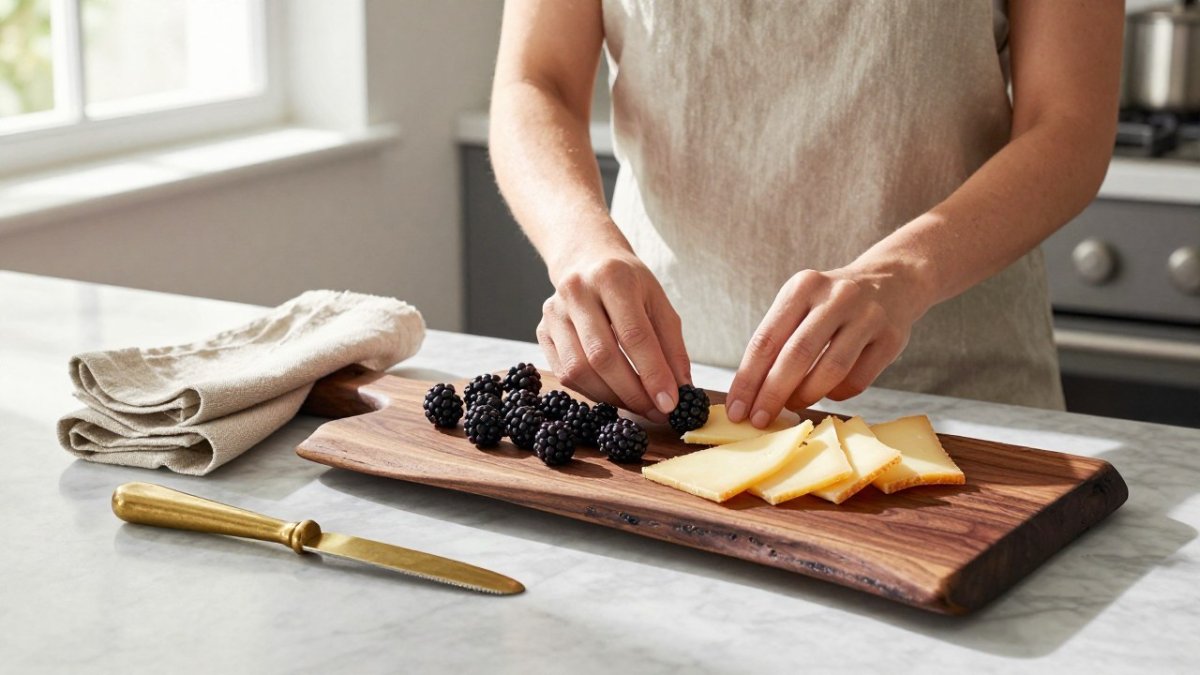
Vary textures and colors deliberately. A board of all beige food looks dull no matter how good it tastes; a handful of dark berries or a sprig of rosemary changes the composition.
Watch Out Don't slice everything in advance. Pre-cut cheese dries out and pre-folded meat goes limp within an hour. Slice a portion, let guests graze, then replenish from the kitchen.
Charcuterie Board Maintenance Tips for Decades of Use
Charcuterie board maintenance tips come down to three habits: wash gently, dry completely, and re-oil regularly. Skip any one of them and even a premium board will suffer.
Wash gently. Hand wash with warm water and mild soap, then rinse and dry immediately with a towel.
Dry completely. Stand the board on edge so air reaches both faces. Never stack a damp board flat against a counter.
Re-oil regularly. Apply a food-safe board conditioner in thin coats, let it soak in, and buff off the excess.
Manage stains and odors. A paste of baking soda and water lifts most stains and smells.
Pro Tip Keep a small bottle of board conditioner next to your cutting boards. The boards that last decades are the ones whose owners re-oil them on a schedule, not the ones that get the most expensive finish at purchase.
Personalization, Gifting, and What to Expect When You Buy
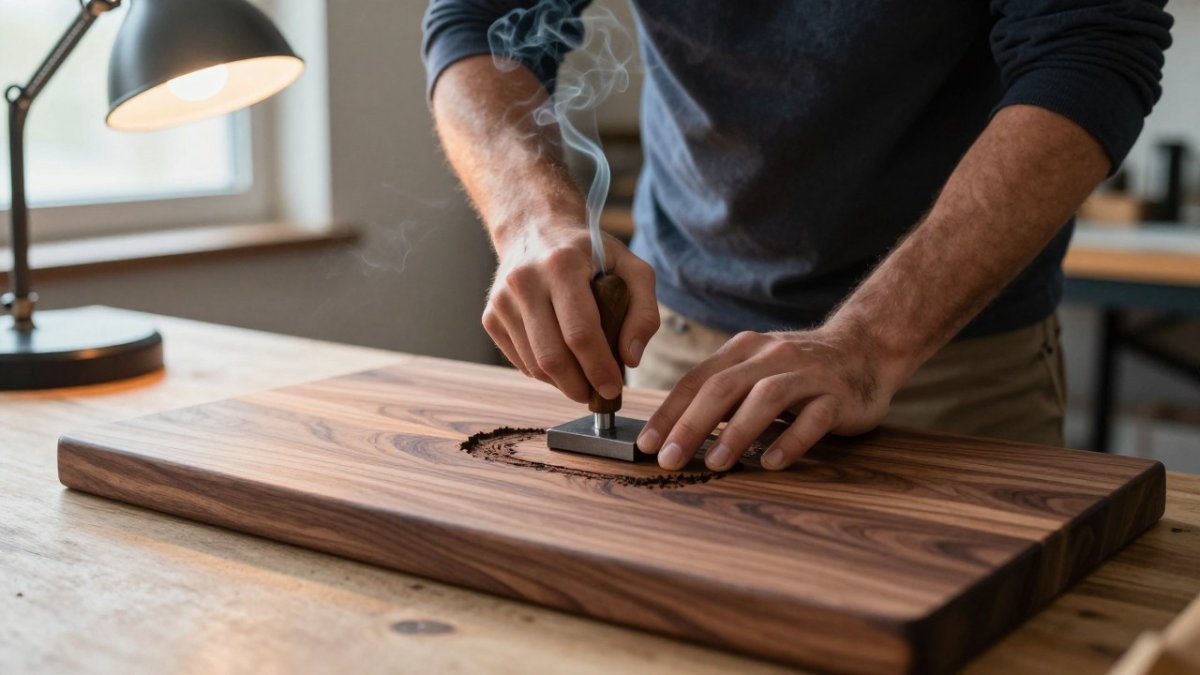
Custom engraving turns a serving board into a gift people keep.
Engraving methods. Laser engraving produces crisp, consistent lettering and fine detail, suiting monograms, dates, and logos.
Proofing. Before production, confirm a digital proof showing the exact text, spelling, font, and placement.
Gift timing. Custom work takes longer than pulling a finished board off a shelf.
Branded serving ware. Wineries, merchants, and tasting rooms have a different set of questions.
What drives price. We'd rather be straight with you than quote a number that won't hold.
Best For Gift shoppers who want a wedding or anniversary present that won't be duplicated, and wineries or merchants who want branded serving ware that carries their name onto the table.
To see current prices or request a quote for a custom piece, check our store or reach out with your species, size, and engraving details.
Conclusion
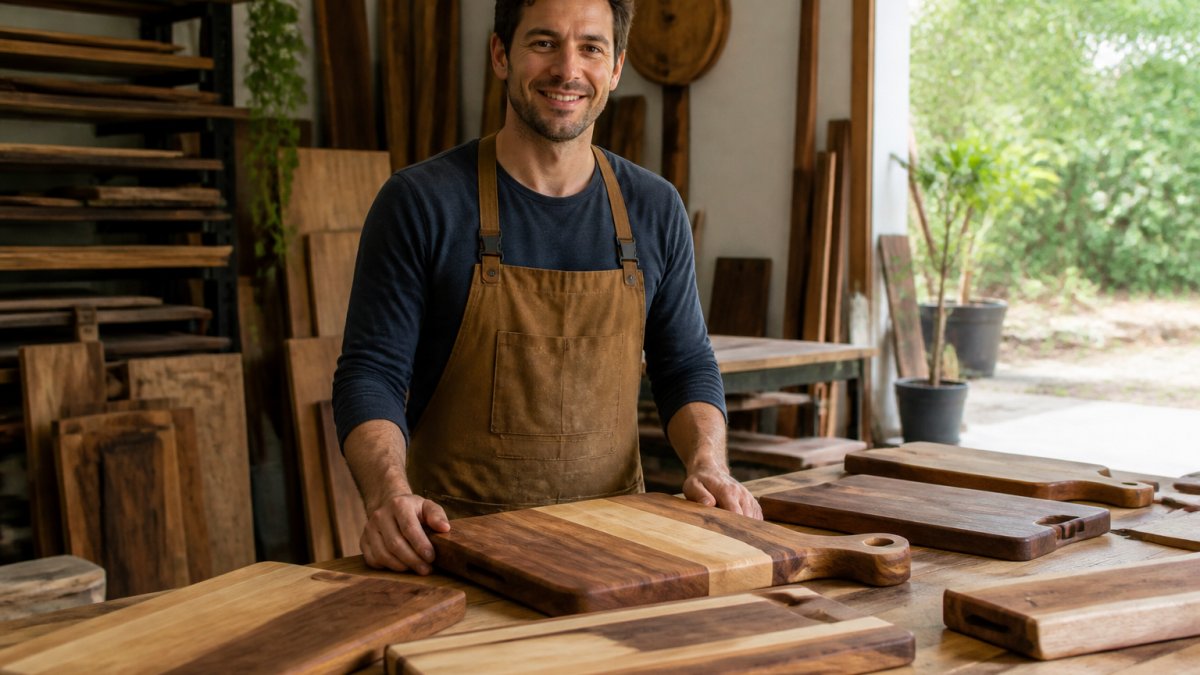
Choosing a board that survives a decade of dinner parties means looking past the listing photo and asking harder questions about wood species, grain matching, finish, and repairability. That's the standard we build to at Unhinged Woodworks: hand-selected hardwoods like black walnut, cherry, and African mahogany, grain matched for stability, finished with food-safe adhesives and conditioners, and available with custom engraving and branding. If you want a centerpiece that earns its place on your table for years, explore the collection.
Frequently Asked Questions
What wood is best for a charcuterie board?
Hardwoods like black walnut, cherry, maple, and African mahogany are the best choices because their tight grain resists knife marks and moisture. Black walnut brings a deep, dramatic grain that suits serving and display, while maple offers a pale, neutral surface that lets food colors stand out. Acacia and bamboo work as lower-cost options but tend to show wear faster. When you buy handcrafted wooden charcuterie boards, check that the maker names the species and finishes it with food-safe oils rather than a lacquer.
How do you maintain a handcrafted wooden charcuterie board?
Hand wash with mild soap and warm water, then dry immediately and stand the board on edge so air reaches both faces. Never soak it or put it in the dishwasher, since heat and prolonged water exposure cause warping and cracks. Re-oil every four to six weeks with a food-safe mineral oil or a board conditioner, and apply more often if the wood looks dry or pale. Store it away from direct heat and sunlight. These charcuterie board maintenance tips keep the finish satin-smooth for decades.
Are handcrafted wooden boards food safe?
Yes, when the maker uses food-safe adhesives and finishes. Hardwood's tight grain limits how deeply bacteria can settle, and a pre-oiled natural finish seals the surface without a chemical film. Avoid boards finished with lacquer, polyurethane, or unknown stains if you plan to serve directly on them. Ask the maker what conditioner they recommend and whether the board ships pre-oiled. Re-oiling regularly maintains the barrier that makes the surface safe for cheese, cured meats, and cut fruit.
How can you tell if a wooden board is high quality?
Look at the grain: matched, continuous grain across glue lines signals careful selection, and visible knots or mismatched strips suggest shortcuts. Check the edges for smooth, polished sanding with no raised fibers, and confirm the board sits flat without wobble. A high-quality board feels substantial for its size and carries a clear food-safe finish.
Get Unhinged Today!@
Comments