
Best Wood Serving Platters for Parties: A Host's Buying Guide

Last Updated: November 19, 2026
Quick Summary
The best wood serving platters for parties balance hardness, grain pattern, and moisture resistance, with acacia and teak suiting everyday buffet use and black walnut or cherry making statement charcuterie boards. Size a large wooden serving platter at roughly 8 to 10 square inches of usable surface per guest for cheese and charcuterie, or 12 to 15 square inches when it is the main food station.
Acacia and teak are naturally moisture-tolerant and suit everyday party use.
Subtract about 1 to 2 inches from each side to find a board's real working surface.
Rectangular trays use their footprint most efficiently, which is why caterers favor them.
Hand-wash with mild soap, rinse quickly, and towel-dry within a minute or two.
A board in the 3/4-inch to 1-1/4-inch range stays flat under a heavy spread.
Ready to host with a board that lasts?
Unhinged Woodworks crafts heirloom wooden platters with food-safe finishes and custom engraving.
Table of Contents
Why Wood Serving Platters Belong at Every Party
A wood serving platter does something a ceramic dish cannot: it makes food look meant to be shared. The best wood serving platters for parties work as both vessel and centerpiece.
Wood is also forgiving in ways glass and porcelain are not. It resists chipping, holds up to a crowded buffet, and can look better the more it is used. A charcuterie board passed around a holiday party takes bumps, knife nicks, and oily fingerprints; wood absorbs that wear and keeps its character.
Here is what we will cover: which wood species suit which foods, how to size a large wooden serving platter to your guest count, how a charcuterie board differs from a plain tray, and the cleaning rules that keep a finish intact for decades.
Best Wood for Serving Platters: Acacia, Walnut, Maple, and More
The best wood for serving platters balances hardness, grain pattern, and how the piece handles moisture. Acacia and teak are naturally moisture-tolerant and suit everyday use. Black walnut and cherry bring deep color and fine grain for display pieces. Maple offers a pale, neutral surface that lets food color stand out.
Here is how the common species compare for party use:
Wood | Look | Moisture Resistance | Best For |
Acacia | Bold, contrasting grain | High | Everyday trays, buffet use |
Black walnut | Deep chocolate brown | Medium-high | Statement charcuterie boards |
Maple | Pale, subtle grain | Medium | Cheese, fruit, light foods |
Cherry | Warm reddish tone | Medium | Heirloom gifts, engraving |
Teak | Golden, oily feel | High | Outdoor and humid settings |
Olive wood | Swirling figure | Medium | Decorative serving pieces |
Bamboo | Uniform, light | High | Budget-friendly, lightweight trays |
American hardwood species like walnut, cherry, and maple remain the standard for pieces meant to last.
What most guides miss is that grain direction matters as much as species. A board cut so the grain runs lengthwise resists warping better than a cross-grain cut, which is why hand-selected grain matching is worth asking about. If you want a deeper breakdown of which woods suit boards and platters, read our guide to the best wood for charcuterie and cutting boards.
Choosing a Large Wooden Serving Platter by Guest Count and Shape
A large wooden serving platter should hold roughly one generous serving per guest without crowding, so size up rather than down.
Plan on about 8 to 10 square inches of usable surface per guest for a cheese-and-charcuterie spread, and 12 to 15 square inches per guest when the platter is the main food station. A cocktail-hour crowd that eats standing up clears a board faster than a seated dinner, so lean toward the higher end for passed or buffet service.
Here is how common platter sizes map to guest count using that math:
Platter size (usable surface) | Approx. square inches | Cheese & charcuterie | Full grazing spread |
12 x 8 in | ~96 | 8-10 guests | 6-8 guests |
16 x 10 in | ~160 | 14-18 guests | 10-13 guests |
20 x 12 in | ~240 | 22-28 guests | 16-20 guests |
24 x 14 in | ~336 | 30-40 guests | 22-28 guests |
31 x 12 in | ~372 | 35-45 guests | 25-30 guests |
Treat the table as a starting point, not a rule. Dense, tall piles of cured meat and folded cheese take more surface than the same weight spread flat, and a deep juice groove loses usable area around the perimeter.
Shape changes how a platter works on the table and how much of that surface is actually reachable:
Round platters suit cheese and fruit, encourage grazing from all sides, and look generous on a round table. A round board's usable area is roughly 78 percent of a square of the same diameter, so a 20-inch round holds noticeably less than a 20-inch square.
Rectangular trays fit a buffet line, hold long rows of sliced meat, and stack neatly on a sideboard. They use their footprint most efficiently, which is why caterers favor them.
Paddle-handle boards give guests a grip for passing and double as a serving piece with a built-in handle. The handle eats into usable surface, so a paddle board sized like a plain rectangle will hold less food.
Oval platters split the difference: more usable area than a round of the same width, with softer presentation than a rectangle.
A board that big needs a sturdy table and a clear path, so measure your buffet, cabinet, and doorway clearances before you commit.
Watch out: buying small to save table space usually backfires. Guests take less when a platter looks picked over, and you end up refilling mid-party.
The Wood Charcuterie Board: What Separates It From a Plain Tray
A wood charcuterie board is a serving surface designed for arranged, shareable food, while a plain tray is a flat carrier for whatever you set on it.

Here is what to compare on a party board, feature by feature:
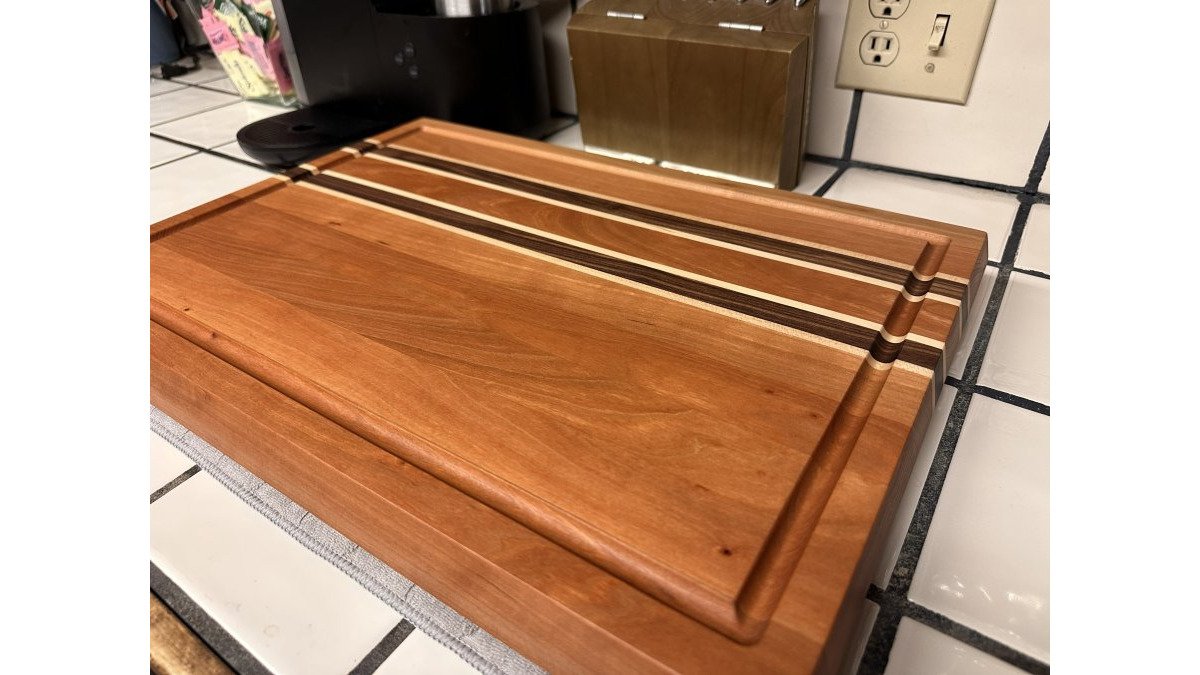
Juice groove vs. raised edge. A routed juice groove catches brine, oil, and fruit juice before it reaches the table. A raised edge does the same with a lip, but makes scraping harder and can trap crumbs. Boards with neither are best for dry foods like crackers, nuts, and cured meat.
Reversible faces. A two-sided board lets you keep one face for cheese and charcuterie and the other for cut fruit or bread, limiting cross-flavors and making mid-party reloads easier.
Handles and grips. A cutout handle or paddle end makes a loaded board safe to pass. Thin boards without a grip flex when loaded, a common failure point at parties.
Thickness and weight. A board in the 3/4-inch to 1-1/4-inch range stays flat under a heavy spread and resists warping. Thinner boards are lighter but more likely to bow.
Portability and outdoor use. For a patio gathering, a board with a groove and a tight-grained, moisture-resistant wood like acacia or teak handles humidity and spills better. A board that will travel needs a flat back and no protruding feet.
Finish and food contact. A food-safe oil-and-butter finish keeps the surface suitable for direct contact with cheese, fruit, and bread. A board finished only for display is not the one to load with food.
Footprint on the table. A board with feet or a thick base reads as a centerpiece; a flat board slides under a buffet line more easily. Match the base to whether the board is the focal point or one of several dishes.
That distinction matters at a party. A charcuterie board is meant to be looked at and grazed from, so the grain becomes part of the presentation. A plain catering tray does the hauling.
Watch out: a board with a deep juice groove and a narrow flat center can look larger than it is, and hosts often overload the groove itself, which makes the board harder to carry and clean.
For a direct look at how shapes and styles compare, our comparison of wooden board shapes for charcuterie walks through round, rectangular, and paddle designs side by side.
How to Clean a Wooden Serving Platter Without Ruining the Finish
The safe way to clean a wooden serving platter is to hand-wash it with mild soap and warm water, rinse quickly, and dry it immediately with a towel. Never soak it, never put it in the dishwasher, and never leave it wet on a counter. Moisture is the one thing that shortens a board's life.
Follow these steps after every party:
Scrape off food scraps with a soft spatula, not a metal scraper.
Wash with a damp cloth and a drop of mild dish soap.
Rinse and towel-dry within a minute or two of washing.
Stand the platter on edge so air reaches both faces.
Recondition with a food-safe board butter when the surface starts to look dry.
A food-safe finish is what keeps the wood from drinking up oils and stains. Our Graze Craze Board Glaze is a food-safe board butter made to maintain that satin-smooth surface between uses. Skip the vegetable oil and the harsh cleaners; both can turn rancid or strip a finish.
What Party Hosts Get Wrong About Wood Serveware
The biggest mistake hosts make with wood serveware is treating it like ceramic. Wood responds to heat, water, and dryness, and a few habits quietly ruin good pieces.
Cutting on the serving face. A charcuterie board is a serving surface, not a cutting board. Knife marks dull the finish and trap food.
Skipping the conditioner. Dry wood cracks. A thin coat of board butter every few uses keeps the grain sealed.
Storing it flat against a counter. Trapped moisture warps a platter. Store it on edge with airflow.
Putting hot dishes straight on the wood. A hot skillet or casserole can scorch the surface. Use a trivet.
Buying on looks alone. Thickness and grain matching tell you more about durability than a pretty top layer.
A common mistake is buying a thin, lightweight board for a party that will see heavy use. Weight and thickness signal how a piece was built, and a platter that flexes under a loaded spread will not last. Whether a premium piece is overkill comes down to how often you host: a board used weekly pays for itself; one used twice a year is a gift, not a workhorse.
Ordering a Custom Engraved Platter for Your Next Gathering
A custom engraved platter turns serveware into a keepsake, and timing matters as much as design. Engraving works best on tight-grained hardwoods like black walnut, cherry, and maple, where fine lines stay crisp.
Plan your order around the event, not the other way around. Our guide to custom wood engraving turnaround times breaks down what drives the timeline and gives realistic estimates before you commit.
When you are ready, think about what the piece will carry. A winery or merchant branding a board will want a logo that reads clearly at a distance.
Your next gathering deserves a centerpiece that works as hard as you do. At Unhinged Woodworks, we hand-select hardwoods like black walnut, cherry, and African mahogany, finish every piece with food-safe adhesives and conditioners, and offer custom engraving and branding for hosts, wineries, and merchants.
Frequently Asked Questions
What type of wood is best for serving trays?
Hardwoods hold up best: black walnut and cherry are the species we work with, and hardwoods generally resist dents and moisture better than soft woods. Walnut and cherry bring warm color and tight grain, while acacia and teak handle heavy use with less fuss. Avoid pine and other softwoods, which dent easily and soak up oils. Whatever wood serving platters you choose, confirm the piece is finished with a food-safe conditioner rather than a hardware-store oil.
What size wooden serving platter is best for a party?
Match the board to the crowd. Match the board to the crowd and the food you are serving. Pricing and sizing options depend on the piece, so check the Unhinged Woodworks store for current options. Rectangular trays fit more cheese and charcuterie; round platters look better as a centerpiece.
Are wooden serving platters safe for food?
Yes, when the wood is finished with food-safe adhesives and conditioners. A properly sealed surface helps keep juices and oils from soaking in. Skip boards with cracks, deep scratches, or a sticky finish, and never leave wet food sitting on wood for hours. Wash promptly, dry fully, and re-oil regularly to keep the surface food-safe.
How do you clean and care for a wooden serving platter?
Hand wash with warm water and a drop of mild dish soap, then dry immediately with a towel and let it air dry standing upright. Never soak it or put it in the dishwasher, since heat and water warp the grain. Re-oil every few weeks with a food-safe board conditioner, and store the platter away from direct sun. For a wood charcuterie board used often, a monthly conditioning routine keeps the satin finish intact.
Comments