
Beautiful Hardwoods You Have Never Heard Of

Last Updated: November 23, 2026
Quick Summary
Beautiful hardwoods like purpleheart, padauk, yellowheart, sapele, and zebrawood bring color and figure that no stain can imitate, and we build serving pieces around exactly these species. They cost more, wear tools faster, and demand patience, but they produce boards people photograph before they dare put cheese on them.
Purpleheart arrives dull brown and turns violet as it oxidizes in light.
Zebrawood's alternating hardness leaves ridges if you sand with too much pressure.
Purpleheart, padauk, and sapele ship in predictable volumes; zebrawood and yellowheart are more intermittent.
Re-oil a working board when water stops beading, typically every four to six weeks with regular use.
Choose sapele for daily cutting and zebrawood for a conversation-starting charcuterie piece.
Ready to see purpleheart in person?
Unhinged Woodworks crafts heirloom serving boards from exotic hardwoods with custom engraving.
Table of Contents
Why Beautiful Hardwoods You Have Never Heard Of Deserve a Place on Your Table
Walk into most kitchens and you will find the same three woods: maple, oak, walnut. Beautiful hardwoods live outside that short list. Purpleheart, padauk, yellowheart, sapele, and zebrawood bring color and figure that no stain can imitate, and at Unhinged Woodworks we build serving pieces around exactly these species.
Here is the honest trade-off up front: these woods cost more, wear tools faster, and demand patience. They also produce boards people photograph before they dare put cheese on them.
U.S. Forest Service Wood Handbook
Exotic Wood Characteristics That Stop a Dinner Party Cold
Exotic wood characteristics start with color and figure that grow in the tree, not in a can. Heartwood carries the deep tones, sapwood stays pale, and grain patterns range from tight stripes to rippling waves.
Three properties matter most when you shop:
Chatoyancy: the shimmer that shifts as you move around a piece
Figure: curls, stripes, and burls formed by how the tree grew
Color depth: pigment that runs through the board, not across its surface

Purpleheart, Padauk, and Yellowheart: Color You Cannot Stain Into Domestic Lumber
Purpleheart arrives dull brown and turns violet as it oxidizes in light. Padauk starts brick red and deepens toward burgundy. Yellowheart holds a clear, buttery gold that no domestic species matches.
These three are the show-offs of the group. They also move more with humidity than maple or walnut, so a maker has to plan grain orientation carefully.
Sapele, Zebrawood, and the Figure That Moves With the Light
Sapele looks like mahogany's livelier cousin, with ribbon stripes that ripple as you walk past. Zebrawood earns its name honestly: bold dark stripes over a pale ground, almost architectural in contrast.
Both are stunning in a charcuterie surface, and both punish rushed sanding. Zebrawood's alternating hardness means soft grain sands away faster than hard grain, leaving ridges if you press too hard.
Hardwood Workability Challenges: Tool Wear, Tearout, and the Patience Tax
Hardwood workability challenges come down to three costs: sharper tools, slower feed rates, and more sanding. Dense tropical species dull blades faster and chip at the edges if a cut is rushed.
A common mistake is treating these woods like oak. They are not. Purpleheart and zebrawood both demand fresh carbide edges and light passes.
Tool wear: expect to sharpen or swap blades more often
Tearout: climb cuts and sharp tooling reduce it, force increases it
Sanding: each grit must fully remove the previous scratch pattern
That is the patience tax. It is also why a handmade board from these species is a different object than a factory cutting board.
Lumber Pricing Factors: Why a Board Made From These Species Costs More
Lumber pricing factors for exotic hardwoods come down to four levers: availability, board width and defect rate, drying method, and the species' reputation in the trade. Tropical species arrive in smaller lots than domestic stock, and clear, wide boards are far scarcer than narrow ones. A 4/4 (one-inch rough) board of purpleheart or zebrawood that is clear on both faces and wide enough for a charcuterie blank is a different product, and a different price tier, than a narrow, checked offcut.
Here is how the levers actually move the number:
Availability: Purpleheart, padauk, and sapele are stocked by most specialty hardwood dealers and ship in predictable volumes. Zebrawood and yellowheart are more intermittent, a dealer may carry them for months, then go a season without a clean lot. Rarer species like tulipwood, pink ivory, or snakewood appear mostly as turning blanks and small shorts, not board stock.
Width and defect rate: Figured boards hide defects under the rough surface. A maker planes a board, finds a wind shake or a pitch pocket, and loses a section. The waste is baked into the price of every board that does survive.
Drying method: Kiln-dried stock is more dimensionally stable and commands more than air-dried, but air-dried figured stock often shows better color. Most premium board makers buy kiln-dried and accept the slight color trade-off for stability.
Sourcing for Hobbyists vs. Professionals
This is where most guides go quiet, and it matters more than any single price tag.
Hobbyists can usually find purpleheart, padauk, sapele, and zebrawood as S4S (surfaced four sides) shorts and turning blanks at local specialty dealers and online hardwood retailers. Yellowheart is hit-or-miss; call ahead. Buying shorts is the cheapest way to try a species before committing to a full board.
Professionals buy by the board foot in lift quantities from importers and millwork suppliers, often with chain-of-custody paperwork attached. The per-board-foot price is lower, but the minimum order is larger and the lead time is measured in weeks, not days.
The middle path, a small shop buying one or two wide boards at a time, is where most custom board makers live.
Pricing depends on species, board size, and the piece's finishing and engraving. For current prices or a quote, visit the Unhinged Woodworks website.
Density, Janka hardness, and How Each Species Ages on a Working Board
Density and Janka hardness predict how a board behaves under a knife. Janka measures the force needed to embed a steel ball halfway into the wood; higher numbers resist dents but feel harder under the blade and demand more from your tools. The numbers below are the commonly published Janka ratings for these species, treat them as a comparison tool, not a guarantee, since density varies by board and by growing region.
Species | Janka (lbf) | Density (lb/ft³, approx.) | Color | Grain Character | Working Notes |
Purpleheart | ~1,860 | ~52 | Violet, deepening with light | Straight to wavy | Dulls edges fast; striking contrast |
Padauk | ~1,630 | ~47 | Brick red to burgundy | Open, coarse | Oily; wipe before gluing |
Yellowheart | ~1,780 | ~50 | Clear golden yellow | Fine, uniform | Holds color well; moderate wear |
Sapele | ~1,410 | ~42 | Reddish brown | Ribbon stripe | Glues and finishes easily |
Zebrawood | ~1,830 | ~50 | Pale with dark stripes | Bold stripe | Prone to tearout; sand lightly |
How These Woods Age Over 10+ Years
This is the part most species lists skip, and it is the part that matters most to someone buying a board to keep.
Purpleheart starts dull brown, turns violet as it oxidizes in light, then deepens toward a dark plum over years. Boards kept out of direct sun hold the violet longer; boards on a bright counter go plum faster. Oil-based finishes slow the shift but do not stop it.
Padauk begins brick red and deepens toward burgundy, then slowly drifts toward a warm brown over a decade or more. The red is most vivid in the first year or two. A UV-blocking finish extends the red phase; mineral oil and beeswax do not.
Yellowheart holds its buttery gold well in indirect light but fades gently in strong sun. Rotate the board on the counter and store it out of a bright window to keep the color even.
Sapele darkens slightly and its ribbon figure becomes more pronounced as the surface oxidizes. It is the most forgiving of the group over time.
Maintenance That Preserves Both Color and Surface
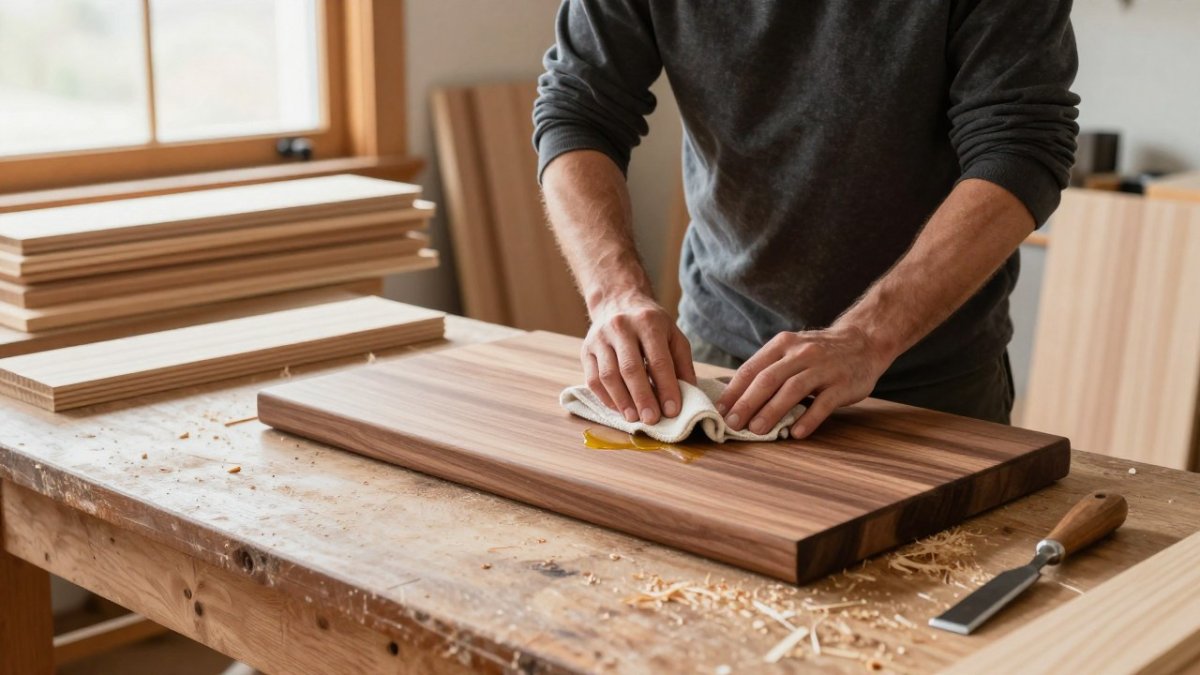
A working board needs re-oiling when water stops beading on the surface, typically every four to six weeks with regular use, less often for a platter that comes out for parties. Use a mineral oil and beeswax blend, let it soak in overnight, and buff off the excess. Never soak these boards in water and never put them in a dishwasher; the density that makes them durable also makes them slow to dry, and trapped moisture is what causes checks.
Watch out: a board that lives near a bright window will show uneven color within a year if you never rotate it, flip it and turn it regularly so both faces age together.
Are Exotic Hardwoods Food-Safe and Responsibly Sourced?
Yes, with two conditions: a food-safe finish and verified sourcing. The wood itself is fine for food contact once sealed with a food-safe oil or wax blend. The bigger question is where it came from.
Many tropical species fall under CITES trade rules, which govern international movement of listed woods. For a deeper walkthrough, read our guide on how to identify sustainably sourced hardwood, and for finish choices see the best food safe finish for wooden boards.
Watch out: an oil finish that is not labeled food-safe can leave a residue on the surface. Stick to mineral oil and beeswax blends.
Matching the Species to the Board You Actually Need
Choose by use, not by color alone. A board that lives on a counter and takes daily knife work wants a dense, closed-grain species. A platter that appears at parties wants drama.
Daily cutting: sapele for balance of durability and warm figure
Statement charcuterie: purpleheart and yellowheart together for contrast
Gift piece: padauk with custom engraving, deep red and personal
Conversation starter: zebrawood, because nobody ignores those stripes
Think about tactile feel too. Dense species feel cooler and glassier underhand; softer-grained boards feel warmer. Neither is better. They simply suit different hosts.
Commissioning a Board Built From Beautiful Hardwoods
The gap between a good board and a great one is in the selection.
That is the answer to the price question. Browse our charcuterie boards to see the species in finished form, or start with our premium heirloom walnut cutting board to see how grain matching works in practice.
A board built from these species is not an impulse buy. It is a piece you choose once and use for years.
Frequently Asked Questions
Why is exotic hardwood more expensive than domestic lumber?
Pricing depends on species, board size, and finishing. For current prices or a quote, visit the Unhinged Woodworks website.
What makes purpleheart and padauk so difficult to work with?
Both are dense, and density drives every hardwood workability challenge. Blades dull faster, burn marks appear if the feed rate drops, and padauk in particular throws fine orange dust that stains light-colored sapwood and shop surfaces. The reward is color no stain can replicate, but it takes sharp tooling, light passes, and patience to get there.
Are exotic hardwoods food-safe for serving platters?
The wood itself is fine for food contact. What matters is the finish and the adhesive. A board finished with a food-safe oil and conditioner, assembled with food-safe glue, is safe for cheese, charcuterie, and sliced fruit. Avoid species with open, splinter-prone grain for knife work and keep highly resinous woods away from direct food contact. Ask the maker which finish they use and how to re-condition the board over time.
How does wood density affect the durability of a cutting board?
Denser species resist dents and moisture penetration better, which is why Janka hardness ratings matter for a board that sees daily knife work. But density cuts both ways: very hard woods dull knives faster and can feel unforgiving under a blade. Many makers pair a dense exotic face with a softer core, or reserve the hardest species for serving boards rather than chopping blocks. Match the density to how you will actually use the piece.

Comments